 Sondra
 Microcurrent point stimulation (MPS) treats scar tissue and chronic pain and helps clients recover from injuries more quickly. MPS stimulates the nervous system and helps decrease to stress and release internal chemical signals to promote healing and pain reduction.
A study in the Journal of Complementary and Alternative Medicine examined a group of 51 chronic pain patients. These patients were given a test to gauge their pain level both before and after treatment. The study showed that after one treatment of MPS, these patients had a 73% average decrease in pain.
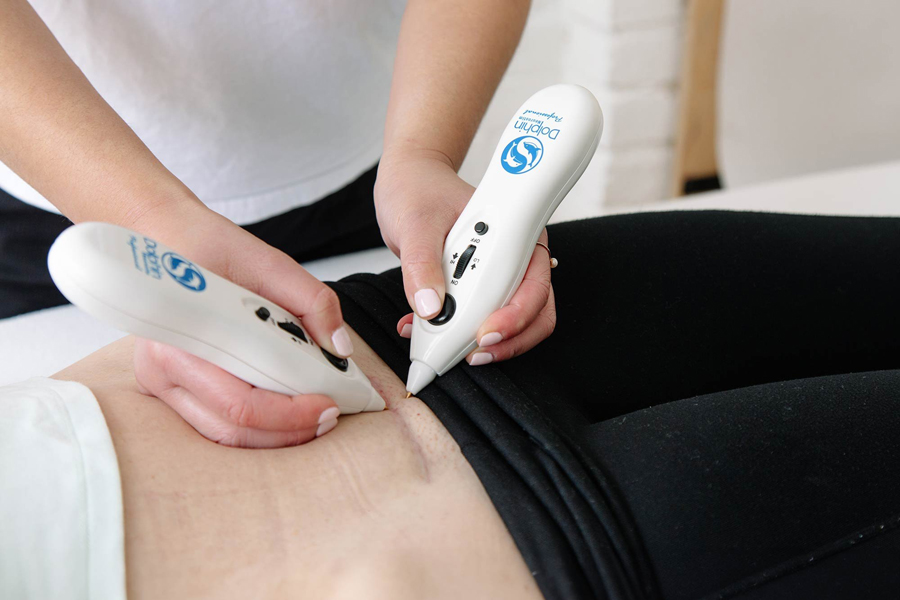
A microcurrent treatment is noninvasive. The Dolphin Neurostim resembles a remote control with a tip on the end — this tip is used to send a small current through tissues of the body, which provides healing benefits.
Armstrong, K., Gokal, R., Durant, J., et al. (2017). The successful treatment of chronic pain using microcurrent point stimulation applied to scars. International Journal of Complementary & Alternative Medicine.
Research — Microcurrent
Allen, C., Williamson, T., Norwood, S., et al. (2023). Do electrical stimulation devices reduce pain and improve function? A comparative review. Pain and Therapy.
Armstrong, K., Chevalier, A., Todorsky, W., et al. (2018). Pain relieving benefits of massage therapy compared to massage therapy combined with microcurrent point stimulation. Journal of Yoga and Physiotherapy.
Armstrong, K., Gokal, R., Chevalier, A., et al. (2017). Microcurrent point stimulation applied to lower back acupuncture points for the treatment of nonspecific neck pain. Journal of Alternative Complementary & Integrative Medicine.
Armstrong, K., Gokal, R., Durant, J., et al. (2017). The successful treatment of chronic pain using microcurrent point stimulation applied to scars. International Journal of Complementary & Alternative Medicine.
Armstrong, K., Gokal, R., & Todorsky, T. (2019). Treatment of chronic post surgical pain using microcurrent point stimulation applied to C-section scars. Integrative and Complementary Medicine.
Armstrong, K., Gokal, R., Todorsky, W., et al. (2018). The successful treatment of chronic pain using microcurrent point stimulation applied to battlefield acupuncture protocol. Journal of Medical-Clinical Research & Reviews.
Bagne, L., Oliveira, M., Pereira, A., et al. (2019). Microcurrent and magnetic electrostimulation: Therapies for the improvement of grafts in bone repair. International Journal of Oral and Maxillofacial Surgery.
Bortolazzo, F., Lucke, L., Fujii, L., et al. (2020). Microcurrent and adipose-derived stem cells modulate genes expression involved in the structural recovery of transected tendon of rats. FASEB Journal.
Cavezzi, A., Paccasassi, S., & Elio, C. (2013). Lymphedema treatment by means of an electro-medical device based on bioresonance and vacuum technology: Clinical and lymphoscintigraphic assessment. International Angiology.
Chevalier, A., Armstrong, K., & Gokal, R. (2016). Microcurrent point stimulation applied to acupuncture points for the treatment of nonspecific lower back pain. Journal of Alternative Complementary & Integrative Medicine.
Chevalier, A., Armstrong, K., Norwood-Williams, et al. (2016). DC electroacupuncture effects on scars and sutures of a patient with postconcussion pain. Medical Acupuncture.
Elio, C., Guaitolini, E., Paccasassi, S., et al. (2014). Application of microcurrents of bioresonance and transdermal delivery of active principles in lymphedema and lipedema of the lower limbs: A pilot study. Italian Journal of Dermatology and Venereology.
Gokal, R., Armstrong, K., Durant, J., et al. (2017). The successful treatment of chronic pain using microcurrent point stimulation applied to scars. International Journal of Complementary & Alternative Medicine.
Gokal, R., Armstrong, K., & Fashong, B. (2020). C-section impact on maternal and fetal health. Positive outcomes with micro point stimulation of C-section scars. Journal of Internal Medicine: Science & Art.
Inoue, M., Nakajima, M., Hojo, T., et al. (2012). Spinal nerve root electroacupuncture for symptomatic treatment of lumbar spinal canal stenosis unresponsive to standard acupuncture: a prospective case series. Acupuncture in Medicine.
Kim, G., Roh, B., Park, S., et al. (2020). Effect of tooth-brushing with a microcurrent on dentinal tubule occlusion. Dental Materials Journal.
Kolimechkov, S., Seijo, M., Swaine, I., et al. (2023). Physiological effects of microcurrent and its application for maximising acute responses and chronic adaptations to exercise. European Journal of Applied Physiology.
Lee, H., Hwang, D., Lee, M., et al. (2022). Micro-current stimulation suppresses inflammatory responses in peptidoglycan-treated RAW 264.7 macrophages and Propionibacterium acnes-induced skin inflammation via TLR2/NF-κB signaling pathway. International Journal of Molecular Sciences.
Luo, Y., Huang, S., Pathak, N., et al. (2021). An integrated systematic approach for investigating microcurrent electrical nerve stimulation (MENS) efficacy in STZ-induced diabetes mellitus. Life Sciences.
McMakin, C. (2004). Microcurrent therapy: A novel treatment method for chronic low back myofascial pain. Journal of Bodywork and Movement Therapies.
Naclerio, F., Moreno-Perez, D., Seijo, M., et al. (2021). Effects of adding post-workout microcurrent in males cross country athletes. European Journal of Sport Science.
Nair, H., & Balakrishnan, A. (2023). Use of microcurrent adjunct wound therapy in a patient with peripheral vascular disease: A case study. Wounds Asia.
Sabel, B., Zhou, W., Huber, F., et al. (2021). Non-invasive brain microcurrent stimulation therapy of long-COVID-19 reduces vascular dysregulation and improves visual and cognitive impairment. Restorative Neurology and Neuroscience.
Saranya, B., Ahmed, J., Shenoy, N., et al. (2019). Comparison of transcutaneous electric nerve stimulation (TENS) and microcurrent nerve stimulation (MENS) in the management of masticatory muscle pain: A comparative study. Pain Research and Management.
Wang, S., Liang, R., Yang, H., et al. (2023). Electroacupuncture for relieving itching in atopic eczema: study protocol for a multicenter, randomized, sham-controlled trial. Frontiers in Medicine.
Whitcomb, E., Monroe, N., Hope-Higman, J., et al. (2013). Demonstration of a microcurrent-generating wound care device for wound healing within a rehabilitation center patient population. Journal of the American College of Clinical Wound Specialists.
Wirsing, P., Konstantakaki, M., & Poulas, K. (2019). Martorell’s ulcer successfully treated by wireless microcurrent stimulation technology. Advances in Skin & Wound Care.
Xu, X., Zhang, H., Yan, Y., et al. (2021). Effects of electrical stimulation on skin surface. Acta Mechanica Sinica.
Zhang, J., Huang, S., Gao, X., et al. (2021). Influence mechanism of heavy metal removal under microcurrent action. Separation and Purification Technology.
Additional Information
Bioelectricity scholarly research | Monterey Cellular Therapy
How do we explain what microcurrent is and what it does? | Greg Martin Skin
Is this 5-minute microcurrent facial better than botox? | Healthline
Microcurrent electrical neuromuscular stimulation | Physiopedia
Microcurrent point stimulation | Pantheon Research
Microcurrent point stimulation: A new hope | USA Today
The content of this site, such as text, images, graphics, and other material, is for informational purposes only. This content is not intended to be a substitute for professional medical advice, diagnosis, or treatment. Always seek the advice of a qualified physician or other health provider regarding any medical condition.
Chou, R., Deyo, R., Friedly, J., Skelly, A., Hashimoto, R., Weimer, M., … & Brodt, E. D. (2017). Nonpharmacologic therapies for low back pain: a systematic review for an American College of Physicians Clinical Practice Guideline. Annals of Internal Medicine, 166(7), 493-505.
Richter, D., Karst, M., Buhck, H., & Fink, M. G. (2017). Efficacy of fascial distortion model treatment for acute, nonspecific low-back pain in primary care: A prospective controlled trial. Alternative therapies in health and medicine, 23(5), 24-32.
Typaldos, S. (1994). Introducing the fascial distortion model. AAO Journal, 4(2), 14-18.
Lee, W. J. (2019). Effect of fascial distortion model on the cobb’s angle in adolescents with idiopathic scoliosis. The Journal of Korean Physical Therapy, 31(1), 31-34.
Manheimer, E., White, A., Berman, B., Forys, K., & Ernst, E. (2005). Meta-analysis: acupuncture for low back pain. Annals of Internal Medicine, 142(8), 651-663.
Brinkhaus, B., Witt, C. M., Jena, S., Linde, K., Streng, A., Wagenpfeil, S., … & Willich, S. N. (2006). Acupuncture in patients with chronic low back pain: a randomized controlled trial. Archives of Internal Medicine, 166(4), 450-457.
Ernst, E., & White, A. R. (1998). Acupuncture for back pain: a meta-analysis of randomized controlled trials. Archives of Internal Medicine, 158(20), 2235-2241.
Berman, B. M., Langevin, H. M., Witt, C. M., & Dubner, R. (2010). Acupuncture for chronic low back pain. New England Journal of Medicine, 363(5), 454-461.
Koopman, J. S., Vrinten, D. H., & van Wijck, A. J. (2009). Efficacy of microcurrent therapy in the treatment of chronic nonspecific back pain: a pilot study. The Clinical journal of pain, 25(6), 495-499.
Oh, H. J., Kim, J. Y., & Park, R. J. (2008). The effects of microcurrent stimulation on recovery of function and pain in chronic low back pain. Journal of Korean Society of Physical Medicine, 3(1), 47-56.
Armstrong, K., Gokal, R., Chevalier, A., Todorsky, W., & Lim, M. (2017). Microcurrent point stimulation applied to lower back acupuncture points for the treatment of nonspecific neck pain. The Journal of Alternative and Complementary Medicine, 23(4), 295-299.
Sdrulla, A. D., Guan, Y., & Raja, S. N. (2018). Spinal cord stimulation: clinical efficacy and potential mechanisms. Pain Practice, 18(8), 1048-1067.
Dones, I., & Levi, V. (2018). Spinal cord stimulation for neuropathic pain: current trends and future applications. Brain Sciences, 8(8), 138.
Gatchel, R. J., & Rollings, K. H. (2008). Evidence-informed management of chronic low back pain with cognitive behavioral therapy. The Spine Journal, 8(1), 40-44.
Keefe, F. J. (1996). Cognitive behavioral therapy for managing pain. The Clinical Psychologist, 49(3), 4-5.
Sveinsdottir, V., Eriksen, H. R., & Reme, S. E. (2012). Assessing the role of cognitive behavioral therapy in the management of chronic nonspecific back pain. Journal of Pain Research, 5, 371.