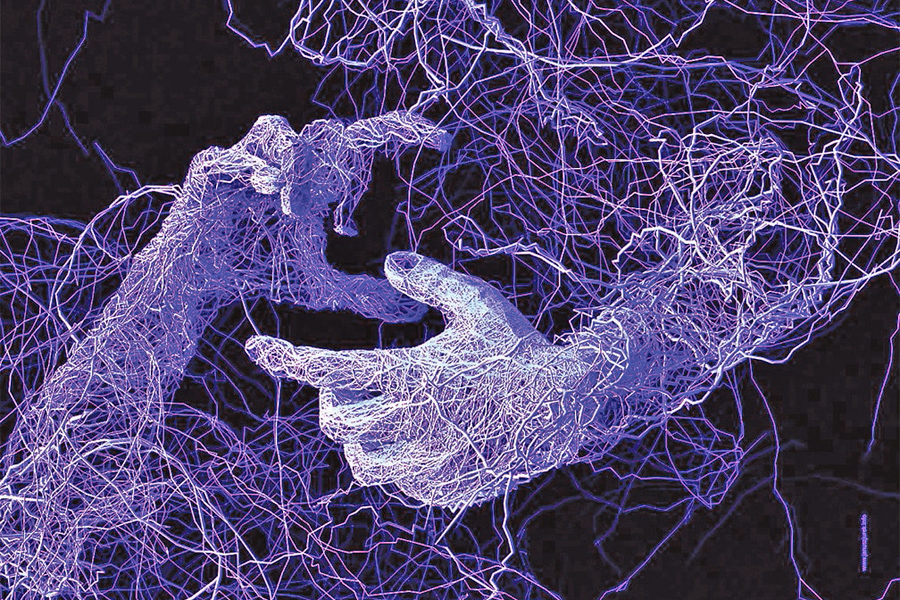
Fascia acts as a biological antenna and liquid crystal lattice, transmitting electrical, mechanical, and informational signals throughout the body. As a collagen-based network, it acts as a piezoelectric system, generating electrical charges from movement and storing structured water that serves as a semiconductor for rapid, body-wide communication.
Piezoelectricity. When stretched or compressed, fascia generates electrical currents, similar to quartz crystals, allowing it to act as a responsive, energetic antenna.
Liquid crystal network. Fascia consists of triple-helix collagen molecules that form a liquid crystal matrix, highly sensitive to light, sound, and electromagnetic frequencies.
Structured water component. Collagen fibers form nanotubules containing structured water (H3O2), which acts as a “battery” to facilitate energy transmission and signaling.
Information transfer. Fascia acts as a signaling network, receiving and emitting information throughout the body.
Impact of movement. Healthy movement and hydration are critical for keeping this system conductive, preventing the fascia from becoming rigid and reducing its signaling capability.
This network is increasingly recognized for its role in bodily communication that goes beyond the nervous system, affecting how we move and feel.
Yes, fascia can release cytokines.
Fibroblasts and myofibroblasts. The primary cells found within connective tissue, known as fibroblasts (and their contractile variants, myofibroblasts), actively synthesize and secrete inflammatory signaling molecules. When subjected to mechanical strain, trauma, chronic stress, or chemical irritation, they release pro-inflammatory cytokines such as IL-1β, IL-6, and TNF-α.
Resident immune cells. Fascia is not an inert structural wrapping; it is a dynamic, vascularized, and innervated tissue that houses immune cells like mast cells, macrophages, and lymphocytes. These cells release inflammatory mediators, histamines, and cytokines in response to injury or nociceptive (pain) signals.
Mechanical and metabolic triggers. Physical stress, chronic inflammation, or manual/mechanical loading can stimulate these cellular responses, shifting the local tissue environment either toward an acute inflammatory/repair cascade or (when balanced) toward anti-inflammatory cytokine expression (such as IL-4 and IL-10 during tissue recovery).
Research
Liptan, G. (2010). Fascia: A missing link in our understanding of the pathology of fibromyalgia. Journal of Bodywork and Movement Therapies.
Pirri, C., Pirri, N., Petrelli, L., et al. (2025). An emerging perspective on the role of fascia in complex regional pain syndrome: A narrative review. International Journal of Molecular Sciences.
Slater, A., Barclay, S., Granfar, R., et al. (2024). Fascia as a regulatory system in health and disease. Frontiers in Neurology.
Tuckey, B., Srbely, J., Rigney, G., et al. (2021). Impaired lymphatic drainage and interstitial inflammatory stasis in chronic musculoskeletal and idiopathic pain syndromes: Exploring a novel mechanism. Frontiers in Pain Research.
van Amstel, R., Schipholt, I., Weide, G., et al. (2026). Neuroimmune interactions in fascia and myofiber regeneration: a narrative review. Musculoskeletal Science and Practice.
Additional Information
The components in fascia | Fascia Guide