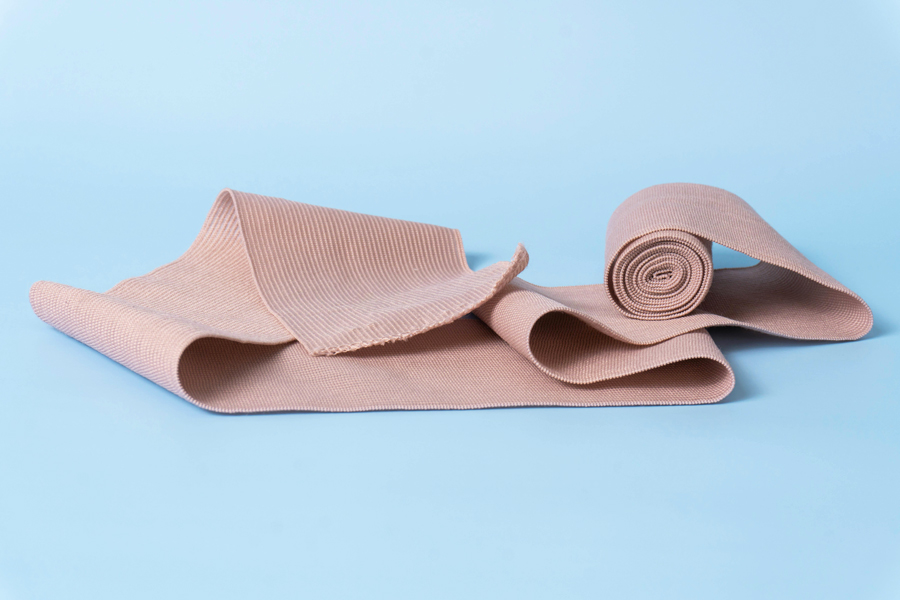
Short-stretch bandages (SSB) are used in the decongestive phase of complete decongestive therapy. SSB are textile-elastic; that is, braided cotton fibers are used in their production, and these bandages are woven to achieve a certain degree of elasticity — these fibers allow for 60% extensibility of the bandage’s original length.
In contrast, long-stretch bandages (LSB) (such as ACE™ bandages) are made with polyurethane — these fibers allow for greater than 140% of the bandage’s original length. This high elasticity exerts low resistance against working musculature and minimal decongestive effect on venous and lymph vessels.
In compression therapy, two different qualities of pressure are differentiated: working pressure and resting pressure. Working pressure describes the resistance the bandage sets against the musculature — the pressure is temporary and is only active during muscle expansion. Its value also depends on the extent of muscle contraction. This active working pressure results in increased tissue pressure, compressing superficial and deep venous and lymphatic vessels and improving the return of fluids within these vessels.
The resting pressure is the pressure the bandage exerts on tissues at rest, that is, without muscle contraction. Its value depends on amount of tension used during application. The higher the stretch (tension), the more pressure the bandage exerts on the tissue.
LSB have high extensibility and therefore result in increased pressure on tissues at rest. They have a high resting pressure and can compress venous and lymphatic vessels, possibly creating a tourniquet effect on the bandaged limb.
The lower elasticity and extensibility of SSB compression results in higher working pressure — SSB exert high working pressure on tissues and form strong support during muscle contraction, and its lower extensibility results in lower resting pressure on tissues at rest. The high working and low resting pressures of SSB make them preferred in the management of lymphedema.
Bandages lose some of their elasticity over time with repeated use and laundering.
To avoid venous and lymphatic constriction and to achieve a compression gradient, bandages are applied in layers.
Follow this link for bandaging supplies.
Zuther, J. (2005). Lymphedema Management: The comprehensive guide for practitioners. Thieme Medical Publishers.
Classes
Medical compression stockings are divided into four compression classes. The higher the compression class, the higher the pressure exerted by the medical compression stocking (resting pressure). The pressure of the compression classes is given either in mmHg (millimeters of mercury) or in kPa (kilopascals).
Class I — 18–21 mmHg or 2.4-2.8 kPa
Class II — 23-32 mmHg or 3.1-4.3 kPa
Class III — 34-46 mmHg or 4.5-6.1 kPa
Class IV — >49 mmHg or >6.5 mmHg
How to Bandage Arms
How to Bandage Legs