
You’ve recently heard of lipedema.
You’re wondering if this matches your symptoms.
You’ve been recently diagnosed.
Either way, you’re probably wondering, “Where do I go from here?”
There is a lot of information to take in when learning about lipedema and/or receiving the diagnosis. This outline has been created to fast track the info, to understand where to begin to learn how to manage lipedema.
Since lipedema’s a chronic condition, you will have to develop some habits to manage it. You also might hear that it’s “progressive,” but that is not necessarily true. There are ways to manage the disease so that progression is slowed or perhaps even stopped, depending upon your current stage. This is why community awareness and discovery are so important — early medical intervention helps to manage pain and inflammation, support mobility, and lower the risk of worsening tissue changes, fibrosis, and secondary lymphedema.
If you’re familiar with stages and types of lipedema, please skip to Section II.
I. What is lipedema?
—-A. Stages of lipedema
How do your tissues look at the present time?
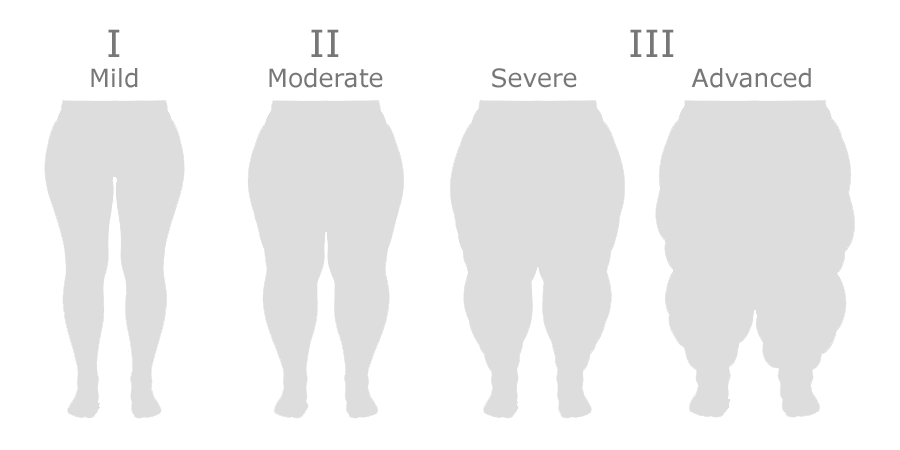
Stage I — Skin surface is normal. Subdermal nodules due to underlying loose connective tissue fibrosis are present.
Stage II — Skin surface is uneven, and dimpling is present due to progressed fibrotic changes and excess tissue. Palpable nodules may be more numerous and larger. In arms, tissue begins to hang off the arm, those patients with full arm involvement show a more pronounced wrist cuff.
Stage III — There is lobular deformation of skin. There are numerous large subdermal nodules and deformities of overhanging lobules of increased lipedema tissue which is more fibrotic in texture.
—-B. Types of lipedema
Where does the tissue tend to develop on the body?
Lipedema is also categorized by the distribution of subcutaneous adipose tissue.
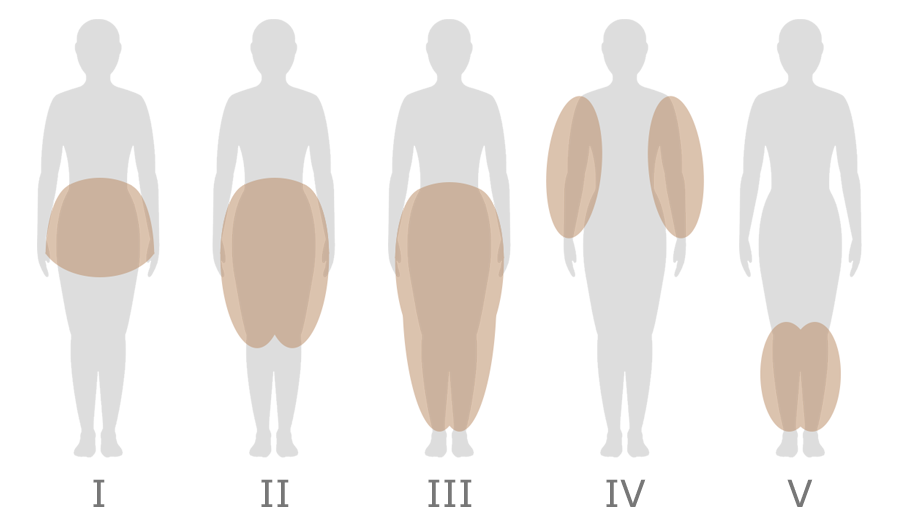
Type I — Tissue is present under the umbilicus and over hips and buttocks
Type II — Tissue is present under the umbilicus to the knees (saddle bags or “jodhpur”)
Type III — Tissue is present under the umbilicus to the ankles
Type IV — Tissue is present in the arms
Type V — Tissue is present in the calves
If you’ve already been diagnosed with lipedema, please skip to Section IV.
II. Evaluation of lipedema
—-A.
How
Assessment by a clinician experienced in lipedema helps evaluate tissue health, mobility, and any coexisting fluid or lymphatic issues.
Even now, in this day and age, it’s difficult to be diagnosed and treated for lipedema.
Finding Lipedema Practitioners
Patient guide to self-diagnosing lipedema | Toronto Physiotherapy
III. Accessing basic resources
—-A. Websites and social media
Finding credible resources is key.
Being able to sort through the myriad of websites and knowing which sources are trustworthy is important, especially when you are looking for information and need to locate a good resource fast. In the past year, many more questionable websites have popped up, each selling an assortment of products and services for lipedema, some of which have even stolen the likeness of known, reliable practitioners. Ask yourself — who is making the claim or selling the service or product? Are they licensed? Credentialled? Chances are that if it sounds too good to be true, it is. If you’d like to read more about this, please see my blog article Buyer Beware.
—-B. Foundations and organizations
Several notable organizations provide valuable resources.
I would say one of the best resources for our community is the Lipedema Foundation. They are a nonprofit founded in 2015 and fund much of the research being done today. They operate a biobank (blood and lipoaspirate collections) and a patient registry to gather patient data, track barriers to diagnosis, and guide future research. They also offer medically-reviewed patient resources and a lipedema provider directory.
Other notable organizations are the Lymphatic Education & Research Network (LE&RN), which supports patients with lymphatic diseases and lipedema through research, education, regional chapters, and advocacy, and the Fat Disorders Resource Society (FDRS), whose annual conference brings together patients, advocates, researchers, and clinicians to share knowledge and advance the understanding and treatment of adipose tissue disorders like lipedema and Dercum’s disease. Another notable patient-focused organization is the American Lipedema Association.
—-C. Research
Research in lipedema is on the increase.
The U.S. Standard of Care was released in 2021. This document centers on early clinical diagnosis and multidisciplinary conservative management. I would recommend printing a copy of this and giving it to all personal physicians and practitioners, as it outlines diagnosing and current treatment of lipedema.
Each year since 2015, the number of lipedema research papers have grown. Much of this research can be viewed at the Lipedema Foundation’s LegATO library. I also keep newer research on lipedema and related subjects here.
IV. Care of lipedema
—-A. Conservative care
Care focuses on symptom relief and slowing progression.
1. Compression garments
2. Pneumatic compression devices (“lymphatic pumps”)
3. Manual therapy
a. Manual lymphatic drainage
b. Soft tissue mobilization
4. Exercise
low-impact exercise like swimming or walking, and anti-inflammatory nutrition guidance
5. Surgical option
When conservative measures are not enough or mobility and pain remain limiting, lymphatic-sparing liposuction may be considered to reduce abnormal fat volume.
Devices and Supplies for Lymph Stasis
Nutrition for Lymph Stasis
Printable Materials for Lipedema
Research on Lipedema
Supplements to Assist Lymph Stasis A-F
Supplements to Assist Lymph Stasis G-M
Supplements to Assist Lymph Stasis N-Z
Supplies and Devices for Lymph Stasis
Symptom Trackers for Lipedema
Laboratory Tests for Lipedema
Dr. Karen Herbst, who is considered the upmost expert in lipedema, has shared a list of lab tests for fat disorders, which lists those lab values she feels necessary to help with diagnosis.
Printable Materials for Lipedema
The Lipedema Foundation has created the informational lipedema brochures in English, German and Spanish for your physicians and practitioners. These can either be printed at home or requested from the Lipedema Foundation.
This is written from the perspective of both a nurse and a patient may be a little dry at times.
Many other printable resources can be found under Patient Resources on the Lymph Out Loud page.
Diagnosing lipedema | Lipedema Foundation
Insights on the pathophysiology, diagnosis and treatment of lipedema | Karen Herbst PhD MD, Wound Care Learning Network
Introduction to lipedema | Thomas Wright MD, Vein Magazine
Lipedema: A devastating disease too often overlooked | Thomas Wright MD, Vein Magazine
Lipedema: A summary | Thomas Wright MD
Lipedema and hypermobility | Thomas Wright MD
Where does lipedema fat accumulate? | Thomas Wright MD