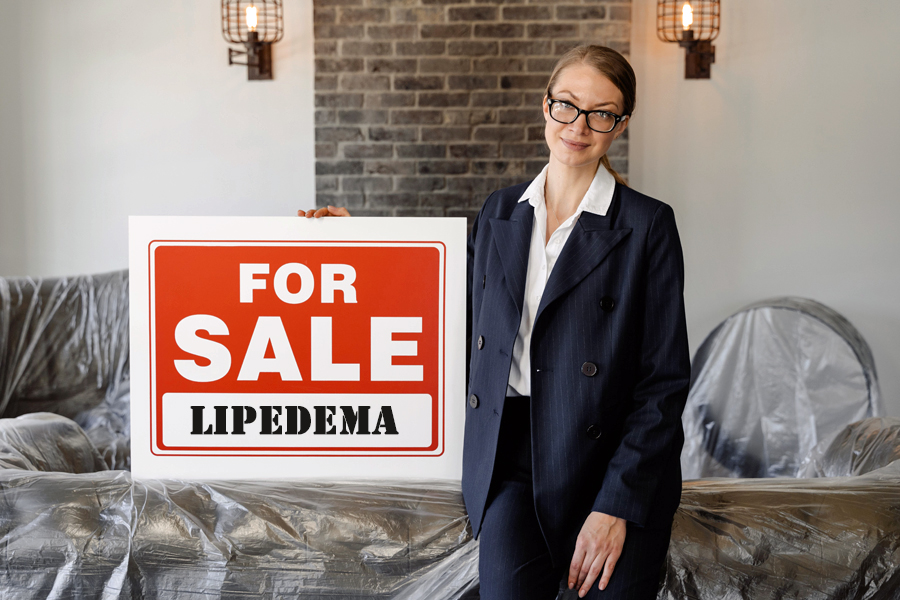
The recent upsurge in products being sold for lipedema is quite staggering. There now seems to be many supplements and devices all promising the same thing — to reduce pain, swelling, and fat build-up. Services are being lauded on every corner of social media, promising solutions for lipedema.
This entire trend is worrisome, as there are many in our community who may be taken advantage of by these claims. How would one know which products or services are legit? A little investigation goes a long way.
Does it sound too good to be true? Then it probably is. The bottom line is to ask these questions: What verification(s) does the company who is formulating this supplement have? What is the education, licensure, or certification(s) of the vendor selling this product or service?
Validating Supplements
Manufacturing Practices
Pharmaceutical grade manufacturing strictly refers to products that meet the rigorous purity, safety, and consistency standards established by regulatory bodies like the FDA and organizations such as the US Pharmacopeia. The production of these therapeutics must adhere to Current Good Manufacturing Practices (cGMP) regulations. To achieve and maintain pharmaceutical-grade compliance, manufacturers must establish comprehensive quality systems — this includes process validation, rigorous documentation of all operations, and regular audits to trace raw materials from source to final drug product.
In addition, production environments require strict environmental controls to prevent contamination, cross-contamination, and mix-ups. This involves using cleanrooms, maintaining specific air filtration systems, and validating manufacturing equipment. All employees must be properly trained, qualified, and equipped to execute their assigned roles, minimizing human error and variability. Every batch of the product must be tested for identity, strength, quality, and purity before it is released for distribution. This ensures the absence of impurities and verifies the compound will degrade and dissolve exactly as intended.
Manufacturing Verifications
Top-rated supplement companies rely on rigorous manufacturing practices and third-party verifications to ensure purity and potency. United States Pharmacopeia, NSF International, and ConsumerLab are the three major independent, third-party organizations that test vitamins and supplements. They verify that products contain the ingredients listed on the label, dissolve properly, and are free from harmful contaminants like heavy metals.
……….United States Pharmacopeia (USP) is a nonprofit organization that sets the strictest standards for identity, potency, and purity. USP verifies that supplements are made in facilities complying with FDA cGMP and tests for contaminants. Verified products can be found using the USP Verified Product Database.
……….NSF International (NSF) is a not-for-profit group. Their general “NSF Contents Certified” seal verifies label accuracy and purity. Certified products can be found on the NSF Certified Dietary Supplements site.
……….ConsumerLab (CL): A for-profit company that tests and regularly purchases supplements off the shelf for comprehensive reviews. Instead of only certifying products submitted by manufacturers, ConsumerLab tests categories against their own independent benchmarks.
Validating Services
Understanding Credentials
Credentials are official qualifications, documents, or digital data that prove a person’s identity, authority, or expertise. They serve to build trust and verify that someone is qualified for a job.
Professional and academic credentials are documented achievements that prove skills and expertise. They demonstrate to employers or clients that the recipient has the required background to do a specific job. Examples are university degrees, diplomas, professional certifications, and state licenses.
Licensing Versus Certification
A license is an official document or formal permission granted by an authority that allows a person to own, do, or use something — it essentially converts an otherwise restricted or unlawful action into a legal and authorized one. A professional license authorizes a person, such as a doctor, nurse, therapist, lawyer, or pilot, to practice their specific trade. Professional licensure is the official state authorization required to practice in a regulated field. Requirements vary by profession and state but typically mandate a specific degree, documented work experience, background checks, and passing national or state exams.
A certification is a credential that verifies a person’s knowledge, skills, and abilities to perform a specific job or work in a specific field. They carry significant weight and recognition, assuring professional competence alongside an academic degree or work experience. Professional and industry certifications are usually issued by private companies, professional associations, or independent testing bodies, rather than the government, and generally require passing an assessment or exam and completing ongoing education to maintain.
Licenses are legally required by government agencies to practice a profession, making them non-negotiable. Certifications are usually voluntary and issued by private professional organizations to showcase advanced, specialized expertise rather than basic legal permission to work. Certifications can be misleading because the market is flooded with deceptive terminology and paid-for badges that imply rigorous third-party assessment but lack actual standardized verification. Understanding how they are awarded is essential.
Physical therapists, occupational therapists, therapy assistants, massage therapists, and all levels of nursing are licensed by their individual states and must meet certain educational and training requirements. Mandated postsecondary education must be completed, as well as background checks and state-administered exams. Because requirements vary by jurisdiction, local regulatory agencies enforce standards to ensure competency.
Therapists and nurses are bound by strict legal, educational, and ethical mandates to protect clients and can face disciplinary action or lose their license for making false or misleading claims about the health benefits of certain treatments or providing advice or treatments that cause direct injury to a client. Legal and ethical boundaries strictly govern what therapists and nurses can and cannot advise.
Certification Versus Certificate
A true certification requires an independent, third-party assessment to verify that a professional meets educational prerequisites and requirements and standardized, practice-based skills. In contrast, a certificate often merely proves completion of a specific course, without evaluating whether a person can apply the skills on the job.
Misleading Terminology and Practices
Some professions feature unofficial, self-designated boards that are not recognized by official regulatory bodies, and yet they grant “board-certified” credentials. Many courses are also heavily marketed as having certifications, but the exams, if required, only test short-term memorization. Recipients often pass the test, get the badge, and forget the practical application. There is no licensure and therefore no oversight.
To determine if a certification is valid, look at the company which is offering certification and how employers in that industry would view it. Search for the certification on major platforms like LinkedIn to see if it is listed as a preferred skill. Certifications created directly by industry-leading companies are widely recognized and highly respected as they prove practical skills. A true certification requires passing a rigorous, standardized, and proctored exam. If they simply grant a certificate for paying the fee or watching videos, it is not a rigorous certification.
Another flaw in this scheme is the number of vendors without any formal (medical) education giving advice and pushing products or services. This is particularly troublesome in that their claim is that since they have “experienced” the disease, they can consider themselves experts. While this may be true, they are still capable of errant or dangerous advice which sometimes goes against sound medical practice.
Credentialing is Important
Without verifications of manufacturing practices or of licensure or certifications required of the seller, it’s buyer beware, as there are no restrictions placed on the vendor — they basically have nothing to lose and everything to gain.
In the recent past, scammers have begun to frequently target the lipedema community, preying on those desperate for relief. If you have been targeted, you are not alone, but there are steps you can take to protect your money and your health.
……….Since there is no known cure for lipedema, be highly skeptical of products making “miracle” promises, like creams, patches or pills claiming to dissolve, burn, or eliminate lipedema fat. At this time, there are no topical treatments or oral supplements proven to reverse the condition.
……….Scammers have recently used artificial intelligence to clone the voices and faces of doctors and celebrities to create endorsements in order to sell fake products.
……….Look for formal education, licensure, and/or industry-wide certifications when shopping for services.
Additional Information
Woman speaks out after being scammed by ad with deepfake of her doctor: ‘Desperate and in pain’ | Today