
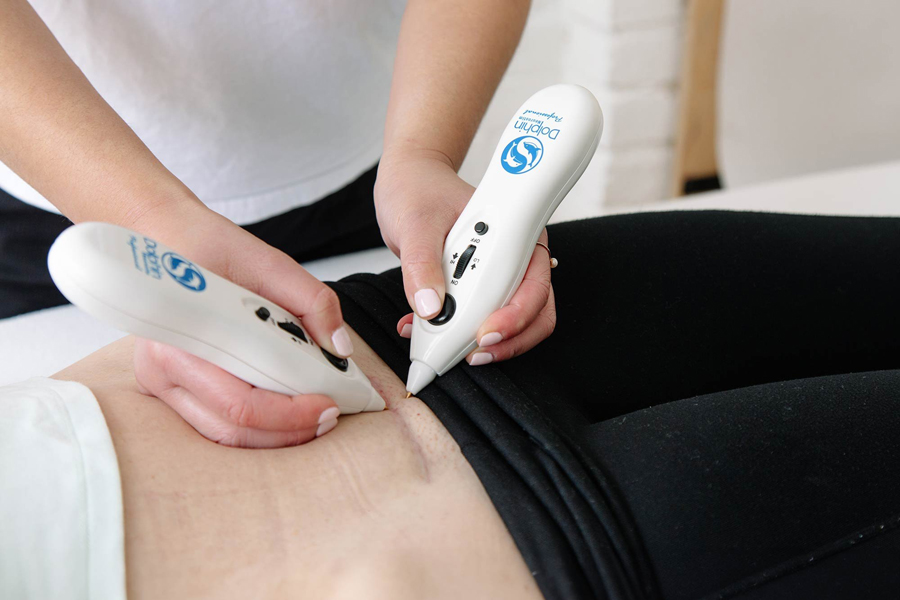
Microcurrent therapy, often called microcurrent electrical neuromuscular stimulation (MENS), is an electrotherapy that uses low-level, sub-sensory currents (in microamperes) to mimic the body’s natural bio-electrical signals; microcurrent units produce electrical current just above the levels of the electrical exchanges that occur at a cellular level in the human body. This is why microcurrent is readily accepted by the body’s cells when applied to the body using conductive electrodes. Unlike traditional muscle stimulators that cause contractions, MENS aims to promote tissue repair, reduce inflammation, and accelerate healing at the cellular level
The theory behind microcurrent therapy is that introducing a surface application of microamperes to the body can restore lost positive and negative electrons. These electrons are the very essence of every living cell. The body can utilize this outside source of minute electrical currents to accelerate its healing mechanisms.
When cells are damaged, they become electrically imbalanced. Because microamperes are close to the electrical level of the body’s cells, applying microcurrent can help rebalance a cell’s electricity — this returns damaged cells to a normal state and initiates cellular activity. Electrical current naturally takes the path of least resistance through the body, which means at the site of an injury, the body’s electrical current will go around the defect rather than through it.
The body’s own electrical current likes to go around any injury, taking the path of least resistance, and it’s an ongoing process to heal damaged cells and microcurrent. By applying microcurrent to the site of an injury, the microamperes current can pick up where the body fails. Through regular microcurrent treatments, the current can gradually close the gap and help heal the damaged area. This helps stimulate healing, accelerates the body’s healing process, and increases the adenosine triphosphate (ATP) level.
Benefits of Microcurrent
Microcurrent therapy has many known benefits and is an excellent foundation for other therapies. Some benefits include:
— Improves circulation and dilates blood vessels
— Accelerates nerve regeneration
— Stimulates lymph circulation
— Increases adenosine triphosphate (ATP) production
— Lengthens connective tissue
— Reduces adhesion formation and mitigates fibrosis
Microcurrent and adenosine triphosphate (ATP).
Some biologists consider ATP as the “currency of life.” It is a dynamic reservoir of energy that is integral to the function of nearly every cell in the body.
ATP is used in muscle contraction, protein biosynthesis, and nerve transmission. One of the exciting elements of microcurrent therapy is that research has shown that applying microamperes can increase ATP production by up to 500%. This information can be found in the study by Cheng, et al. (1982), “The effects of electric currents on ATP generation, protein synthesis, and membrane transport of rat skin.”
This is important because ATP supplies can often become diminished at the site of an injury. Also, unlike other forms of electric therapy, microcurrent has a cumulative effect on ATP levels. Therefore, by applying microcurrent, ATP levels can be increased, and the body’s healing process accelerates.
How does microcurrent differ from TENS?
Based on FDA classification, transcutaneous electrical nerve stimulation (TENS) units cover the complete range of devices that use electrical current applied through the skin. However, traditional TENS units are in the milliamperage range, whereas microcurrent units are in the lower microamperes range. Microcurrent devices start with a microampere (uA) — one-millionth of an amp — rather than a milliampere (mA), which is one-thousandth of an amp.
The popular TENS units in the higher milliamperage range are commonly used as a prescription for pain control as an alternative to prescription drugs. The difference between typical TENS units and microcurrent units is that milliamperes block pain signals to the brain versus microamperes, which provide pain relief and stimulate healing. Microcurrent is a very low level of electrical current that operates in microamperes, and microcurrent therapy is the surface application of this current.
How is microcurrent utilized in therapy?
The variety of units and accessory electrodes make it possible to customize treatments by length of treatments, methods, frequency, etc.
Microcurrent point stimulation (MPS) treats scar tissue and chronic pain and helps clients recover from injuries more quickly. MPS stimulates the nervous system and helps decrease to stress and release internal chemical signals to promote healing and pain reduction.
A study in the Journal of Complementary and Alternative Medicine examined a group of 51 chronic pain patients. These patients were given a test to gauge their pain level both before and after treatment. The study showed that after one treatment of MPS, these patients had a 73% average decrease in pain.
A microcurrent treatment is noninvasive. The Dolphin Neurostim resembles a remote control with a tip on the end — this tip is used to send a small current through tissues of the body, which provides healing benefits.
Armstrong, K., Gokal, R., Durant, J., et al. (2017). The successful treatment of chronic pain using microcurrent point stimulation applied to scars. International Journal of Complementary & Alternative Medicine.
Research
Additional Information
Bioelectricity scholarly research | Monterey Cellular Therapy
Clinical microcurrent stimulators: How they work and what they treat | Pantheon Research
Electrical stimulation in wound healing | Wetling Health
Healing wounds, reducing pain, and improving lives SLIDES Clover Medical Solutions
How do we explain what microcurrent is and what it does? | Greg Martin Skin
Is this 5-minute microcurrent facial better than botox? | Healthline
Microcurrent electrical neuromuscular stimulation | Physiopedia
Microcurrent point stimulation: Benefits and science | Pantheon Research
Microcurrent point stimulation: A new hope | USA Today
Microcurrent therapy for lymphatic flow & inflammation reduction | Pantheon Research
The natural bioelectrical wound healing process | Wetling Health
Scar release therapy using microcurrent point stimulation: Release your hidden barriers | Center for Healing and Regenerative Medicine
Taking the pain out of wound healing with microcurrent electrical stimulation therapy | Wounds International