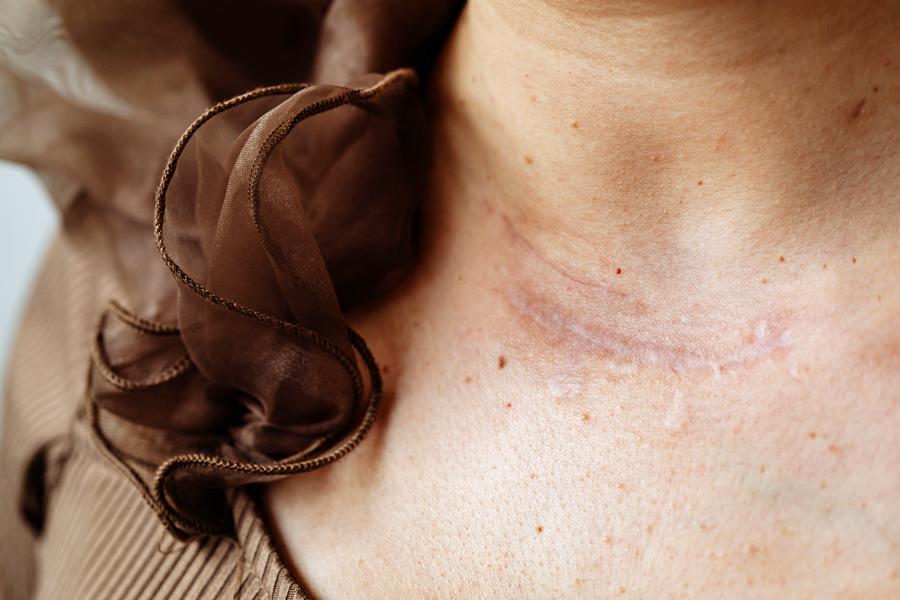
Scars can impact health — physically, functionally, and psychologically — by altering how skin and deep tissues repair themselves after an injury, surgery, or inflammation.
Physical and Functional Impacts of Scars
Scars cause direct physical pain, localized tissue tightness, and systemic functional limitations depending on their depth, location, and severity.
Reduced mobility. Scars, especially contracture scars from burns or large skin losses, pull the skin tight, which restricts movement in nearby muscles, tendons, and joints.
Internal adhesions. Fibrous scar bands can form deep inside the body between unrelated internal organs, muscles, or fascia after surgery or inflammation, sometimes causing chronic pain, stiffness, or digestive changes.
Altered skin function. Surface skin scars are stiffer, weaker, and lack normal hair follicles or sweat glands, making it harder for the body to regulate temperature in those areas.
Local symptoms. Certain scar types like keloids or hypertrophic scars can cause chronic itching, burning, tenderness, or pain.
Scars can also create psychological and social impacts. Visible scars or changes in physical appearance can trigger emotional distress. Research shows roughly 1 in 3 people with noticeable scars experience anxiety or depression. Self-consciousness about a scar’s appearance can lead to social avoidance, reluctance to go out in public, or negative impacts on personal relationships. Some scars can serve as permanent, unwanted visual reminders of past accidents, surgeries, medical emergencies, or physical assaults.
How do scars affect the lymphatic system?
Scar tissue and surgical incisions can also block, pinch, or damage fine lymph vessels, trapping fluid and causing local swelling (lymphedema) or chronic puffiness. Dense collagen fibers in scar tissue and adhesions act as physical roadblocks that prevent lymph fluid from draining normally. Surgical cuts or deep trauma can sever superficial and deep lymphatic collectors, forcing fluid to find alternate routes. U-shaped or tight linear scars can trap fluid inside the enclosed area, leading to long-term localized swelling. Tight scars restrict movement in nearby muscles and the diaphragm, which naturally pump lymph fluid through the body.
Ways to Address Scar Tissue
There are many effective scar management solutions available, and I incorporate several from the list below into scar release sessions, utilizing cross-friction massage, negative pressure, microcurrent, and/or gyratory percussion. Lubczynska, et al. (2023), in Effectiveness of various methods of manual scar therapy, advises, “To increase the effectiveness of the scar therapy, it is advisable to use combined treatment.”
McLoughlin Scar Tissue Release
McLoughlin Scar Tissue Release is a gentle, pain-free manual therapy technique designed to remodel scar tissue, ease fibrous restrictions, and improve tissue mobility. Practitioners use light, specific finger-tip movements over the scarred area rather than heavy force which encourages densely bound collagen fibers to open up, which helps increase blood and lymph flow.
Individual treatments typically last only about 5 to 15 minutes. This type of scar tissue release is suitable for scars resulting from C-sections, hysterectomies, mastectomies, joint replacements, burns, cuts, animal bites, sports injuries, plantar fasciitis, frozen shoulder, and Dupuytren’s contracture.
Deep Oscillation®
Deep Oscillation® therapy (DOT) uses low-frequency electrostatic fields to create gentle, resonant micro-vibrations that penetrate deep into skin, fat, muscle, and connective tissue. Unlike utilizing deep massage or instrument-assisted soft tissue mobilization, both of which compress tissue, DOT lifts and releases layers to break down adhesions and soften scar tissue. The electrostatic field creates a pulsing, rhythmic pull that expands interstitial spaces without heavy pressure and reaches beneath the surface to address internal adhesions and matted collagen fibers that manual hands can struggle to access. DOT speeds up the clearance of fluid, swelling, and metabolic waste while boosting local oxygenation.
Unlike aggressive scar release methods, DOT can often be applied very early after surgery to guide cleaner healing and prevent dense fibrosis. It breaks up stiff, hardened, or keloid-prone scar tissue and calms localized nerve endings and inflammation around post-surgical sites (such as mastectomies or C-sections). DOT restores glide between the skin and underlying fascial layers and is frequently paired with manual scar therapy massage or manual lymphatic drainage for combined superficial and deep remodeling. The combination of scar therapy techniques and deep oscillation can potentially enhance the overall results of scar management, leading to improved scar appearance, increased range of motion, reduced pain, and improved functional outcomes.
Microcurrent
Microcurrent therapy uses very low-level electrical currents to help soften, remodel, and release tight scar tissue. Microcurrent increases production of adenosine triphosphate to accelerate tissue repair. It stimulates fibroblast activity to organize collagen fibers rather than allowing chaotic, tight fibrosis. It also relaxes contracted fascia and surrounding muscles while reducing post-surgical or injury-related pain.
Microcurrent point stimulation combines direct current (DC) microcurrent with acupoints to release stubborn scar adhesions. If not contraindicated, the Dolphin NeuroStim™ is often used in short, targeted sessions to soften tissue.
Negative Pressure
Negative pressure therapy — utilizing silicone, glass or plastic cups — uses a pulling or lifting force on the skin and underlying fascia to help open lymphatic capillaries, improve fluid movement, and soften hardened scar tissue or fibrosis. The negative pressure gently lifts the skin upward, creating space in the tissue channels for trapped fluid and lymph to flow more freely. Rhythmic suction stretches hardened, scarred tissue to break up deep restrictions and soften fibrosis. The vacuum action also increases local microperfusion, supporting both blood and lymphatic circulation in the treated area.
The LymphaTouch® is a device which combines negative pressure with mechanical vibration. It enhances manual lymphatic drainage therapy by stimulating lymphatic flow, reducing swelling, and easing soft tissue restrictions. It offers an effective solution to support management of lipedema and lymphedema. It offers clinically-proven benefits in many areas, including fascia treatments, fibrosis, lymphedema, pain management, post-injury edema, pre- and post-operative edema, scar therapy, soft tissue mobilization, and sports recovery.
Gyratory Percussion
Gyratory percussion is a specialized mechanical therapy used to break up dense scar tissue, release fascial adhesions, and restore skin glide. Unlike standard massage guns that only move up and down, true gyratory percussors use a patented directional stroking action. This movement delivers forces parallel to the skin surface, mimicking a therapist’s hands performing deep cross-friction massage to manipulate soft tissue safely.
When a wound heals, collagen fibers are often laid down in a chaotic, disorganized pattern, causing the skin to stick to underlying muscles and tendons. Gyratory percussion targets this in four ways:
Shearing adhesions. The unique transverse (side-to-side) friction mechanically detaches stuck fascial layers.
Softening fascia. High-frequency waves reduce the densification of ground substance in the fascia, making the tissue more pliable.
Boosting vascularization. Increased local blood and lymphatic flow delivers oxygen to oxygen-deprived (hypoxic) scarred tissue, promoting healthy remodeling.
Desensitization. Regular percussive pulses interrupt pain signals and desensitize hyper-irritable, painful nerve endings trapped in the scar.
Research
Barnes, S., Ma, Y., Patel, B., et al. (2024). Efficacy of massage techniques for hypertrophic burn scars — A systematic review of literature. Journal of Burn Care & Research.
Cao, P., Wang, Y., Guan, H., et al. (2022). Effects of mechanical tension on the formation of hypertrophic scars in rabbit ears and transforming growth factor-β1/Smad signaling pathway. Zhonghua Shao Shang Yu Chuang Mian Xiu Fu Za Zhi.
Deflorin, C., Hohenauer, E., Stoop, R., et al. (2020). Physical management of scar tissue: A systematic review and meta-analysis. Journal of Alternative and Complementary Medicine.
Di Serio, S., Congiu, M., Minnucci, S., et al. (2025). Current physical therapy for skin scar management: A scoping review. Journal of Clinical Medicine.
Dua, N., Burke, E., & Rasmussen, J. (2026). Current best evidence for 5 promising medications used for scar minimization therapy. Plastic Surgery.
Durant, F., & Whited, J. (2021). Finding solutions for fibrosis: Understanding the innate mechanisms used by super-regenerator vertebrates to combat scarring. Advanced Science.
Frasson, D., Valange, M., Almeras, I., et al. (2020). Treatment of immature scars: Manual massages. Textbook on Scar Management: State of the Art Management and Emerging Technologies.
Jeschke, M., Wood, F., Middelkoop, E., et al. (2023). Scars. Nature Reviews Disease Primers.
Junker, J., Kratz, C., Tollback, A., et al. (2008). Mechanical tension stimulates the transdifferentiation of fibroblasts into myofibroblasts in human burn scars. Burns.
Kodumudi, V., Gomez-Lara, A., Baghchechi, M., et al. (2025). Postoperative scar treatment modalities: A systematic review of randomized controlled trials. Journal of Cosmetic and Laser Therapy.
Kumar, V., Kumar, R., & Gupta, S. (2023). An observational study of comparative effectiveness of different manual scar therapy techniques. International Journal of Pharmaceutical and Clinical Research.
Lewit, K., & Olsanska, S. (2004). Clinical importance of active scars: Abnormal scars as a cause of myofascial pain. Journal of Manipulative & Physiological Therapeutics.
Lin, T., Chou, F., Wang, H., et al. (2023). Effects of scar massage on burn scars: A systematic review and meta-analysis. Journal of Clinical Nursing.
Lin, Y., Dai, R., Vogelaar, G., et al. (2024). Organ dependency on fascia connective tissue. American Journal of Physiology — Cell Physiology.
Lubczynska, A., Garncarczyk, A., & Wcislo-Dziadecka, D. (2023). Effectiveness of various methods of manual scar therapy. Skin Research and Technology.
Marafioti, S., Veronese, S., Pecorella, C., et al. (2025). Electromagnetic fields, electrical stimulation, and vacuum simultaneously applied for major burn scars. Bioengineering.
Meretsky, C., Polychronis, A., & Schiuma, A. (2024). A comparative analysis of the advances in scar reduction: Techniques, technologies, and efficacy in plastic surgery. Cureus.
Santuzzi, C., Liberato, F., de Oliveira, N., et al. (2024). Massage, laser and shockwave therapy improve pain and scar pruritus after burns: A systematic review. Journal of Physiotherapy.
Scott, H., Robinson, L., & Brown, T. (2024). Scar massage as an intervention for post-surgical scars: A practice survey of Australian hand therapists. Hand Therapy.
Scott, H., Stockdale, C., Robinson, A., et al. (2022). Is massage an effective intervention in the management of post-operative scarring? A scoping review. Journal of Hand Therapy.
Wong, Y., Smith, R., & Koppenhaver, S. (2015). Soft tissue mobilization to resolve chronic pain and dysfunction associated with postoperative abdominal and pelvic adhesions: A case report. Journal of Orthopaedic & Sports Physical Therapy.
Zhang, Y., Liu, E., Gao, H., et al. (2024). Natural products for the treatment of hypertrophic scars: Preclinical and clinical studies. Heliyon.
Additional Information
6 things to know about scar massage | University of Texas MD Anderson Cancer Center
Massage for scarring | American Massage Therapy Association
How to use essential oils for scars | Medical News Today
Massage guns: How to use them safely and effectively | University of Utah Health
Scar management in hand therapy | Hand Therapy Academy
Scar massage | Alberta Health Services
Scar tissue massage and management | Verywell Health
Scar tissue treatment | Baylor College of Medicine
Scars | Cleveland Clinic
What to do when post-surgical scar tissue is affecting you | Houston Methodist