 Sondra
 The most abundant protein in the body, collagen, plays a crucial role in the structure, strength, and elasticity of tissues, including skin, tendons, ligaments, and fascia. Collagen remodeling is a vital process in healing and repairing tissues and involves the breakdown of old or damaged collagen and the synthesis of new collagen fibers. It has been suggested that massage therapy positively influences this process, aiding in tissue repair, enhancing skin appearance, and improving the function of musculoskeletal tissues.
How does massage therapy influences collagen remodeling?
Stimulation of fibroblasts. Fibroblasts are cells responsible for producing collagen and other extracellular matrix components. Massage therapy can stimulate fibroblast activity, enhancing collagen synthesis and remodeling. This stimulation is crucial for the repair of damaged tissues and can lead to stronger, more resilient tissue structures (Crane, et al., 2012).
Improved circulation. Enhanced blood flow resulting from massage therapy provides necessary nutrients and oxygen to the tissues, supporting the metabolic processes involved in collagen production. Additionally, improved circulation helps in the removal of waste products, including degraded collagen fragments, facilitating the remodeling process (Field, 2014).
Mechanical stress. The physical manipulation of tissues during massage applies mechanical stress to collagen fibers, which can trigger the remodeling process. This mechanical stress encourages the realignment of collagen fibers in a more organized structure, which is particularly beneficial in the healing of scar tissue and improving skin and tissue elasticity (Bove, et al., 2016).
Reduction in inflammation. Chronic inflammation can hinder the collagen remodeling process and lead to the formation of fibrotic tissue, which is less functional than healthy tissue. By reducing inflammation, massage therapy can create a more conducive environment for effective collagen remodeling (Field, 2016).
Evidence supporting massage and collagen remodeling
Research supports the potential of massage therapy in facilitating collagen remodeling. Crane, et al. (2012) found that massage therapy attenuated inflammatory signaling after exercise-induced muscle damage and promoted mitochondrial biogenesis, indirectly suggesting a role in supporting collagen remodeling in damaged muscle tissues.
Bove, et al. (2016) demonstrated that massage therapy reduced fibrosis and assisted in tissue repair, proving the importance of massage in managing scar tissue and enhancing the quality of tissue repair through collagen remodeling.
Massage therapy benefits tissue repair and functionality and plays a significant role in collagen remodeling. Massage can support natural healing processes through mechanisms such as fibroblast stimulation, enhanced circulation, application of mechanical stress, and reduction of inflammation.
The influence of massage on apoptotic signaling (programmed cell death) may be one explanation for its physiologic benefits. Apoptotic signaling of neutrophils has been shown to influence a phenotype change in the macrophage population. The M1 macrophages, which are phagocytic, seek and engulf apoptotic cells and lysed fragments. If an M1 macrophage engulfs an apoptotic cell rather than its lysed parts, it can influence a phenotypic change in which the M1 macrophage transitions to an M2 macrophage, secreting anti-inflammatory products.
Macrophages that engulf apoptotic neutrophils prevent the release of neutrophil cytotoxic chemicals, ceasing respiratory burst and increasing the secretion of transforming growth factor β and interleukin 4. The release of transforming growth factor β and interleukin 4 results in decreased release of proinflammatory cytokines (e.g., tumor necrosis factor α and interleukin 6) and promotes a transition to the Th2 cytokine pathway. The anti-inflammatory nature of the Th2 pathway promotes the repair and regenerative process.
— From Investigating the mechanisms of massage efficacy: The role of mechanical immunomodulation.
How to apply massage?
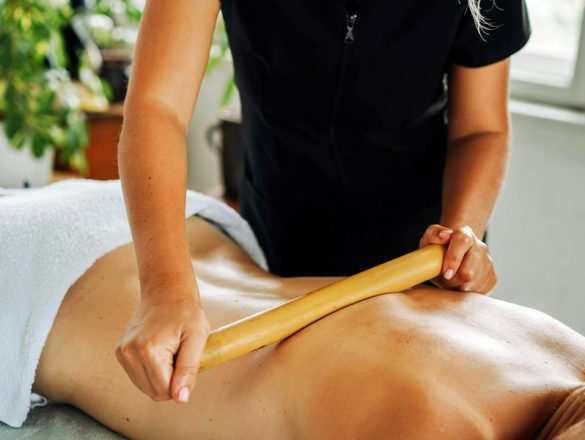
Myofascial release (MFR) is a manual therapy technique aimed at alleviating pain and restoring movement by releasing tension in the fascia. MFR techniques are designed to address chronic pain conditions more effectively. Chronic pain is often linked to fascial restrictions that can lead to musculoskeletal dysfunction. MFR focuses on the fascia, facilitating a holistic approach to pain management.
Use specific techniques. Techniques like cross-fiber friction, myofascial spreading, and circular friction are designed to apply mechanical stress to the tissues and can help break down adhesions and modify the activity of myofibroblasts.
Focus on the affected area. Target the specific areas where you are experiencing tightness or scarring to break down scar tissue and release restrictions.
Be consistent. Regular massage sessions are more likely to have a lasting effect on myofibroblast activity and tissue remodeling than infrequent sessions.
Combine with other therapies. Massage can be used in conjunction with other therapies like physical therapy and exercise to further improve range of motion and function.
Research
Bove, G., & Chapelle, S. (2012). Visceral mobilization can lyse and prevent peritoneal adhesions in a rat model. The Journal of Bodywork and Movement Therapies.
Crane, J., Ogborn, D., Cupido, C., et al. (2012). Massage therapy attenuates inflammatory signaling after exercise-induced muscle damage. Science Translational Medicine.
Ilahi, M., St. Lucia, K., & Ilahi, T. (2023). Anatomy, thorax, thoracic duct. StatPearls Publishing.
Remien, K., Woo, M., & Vilella, R. (2024). Osteopathic manipulative treatment: Lymphatic procedures. StatPearls Publishing.
Van Pelt, D., Lawrence, M., Miller, B., et al. (2021). Massage as a mechanotherapy for skeletal muscle. Exercise and Sport Sciences Reviews.
Warpenburg, M. (2014). Deep friction massage in treatment of radiation-induced fibrosis: Rehabilitative care for breast cancer survivors. Integrative medicine.
Waters-Banker, C., Dupont-Versteegden, E., Kitzman, P., et al. (2014). Investigating the mechanisms of massage efficacy: The role of mechanical immunomodulation. Journal of Athletic Training.
Zhao, N., Liu, B., Liu, S., et al. (2021). The combination of electroacupuncture and massage therapy alleviates myofibroblast transdifferentiation and extracellular matrix production in blunt trauma-induced skeletal muscle fibrosis Evidence-Based Complementary and Alternative Medicine.
Additional Information
Arthrofibrosis | Associated Bodywork & Massage Professionals
Massage doesn’t just make muscles feel better, it makes them heal faster and stronger | Wyss Institute