Microcurrent Point Stimulation (MPS) and Frequency Specific Microcurrent (FSM) both utilize ultra-low electrical currents (microamperes) to promote cellular healing. They differ primarily in precision and methodology.
Standard microcurrent. Microcurrent uses a generalized set of low-level frequencies to stimulate muscles and increase cellular energy (ATP). It treats the tissue as a whole rather than targeting specific conditions. A pen-like probe applies a weak direct current (microampere) current to specific acupuncture points, with precise application with a probe to points, not broad areas. Goals of treatment are to restore the body’s natural electrical balance, modulate the autonomic nervous system, and promote healing.
Frequency specific microcurrent. FSM delivers two separate frequencies simultaneously. One frequency targets the type of tissue (e.g., nerve, muscle, bone), while the second targets the specific condition (e.g., inflammation, scar tissue, or toxicity), creating resonant frequencies to reorganize tissue and promote healing, often boosting cellular ATP. FSM is delivered via electrodes placed on the skin, often in specific protocols. Goals of treatment are to address underlying causes, reduce inflammation, break down scar tissue, and reboot cellular function.
FSM aims for deeper, condition-specific cellular repair by creating resonant frequencies, whereas MPS focuses on restoring overall electrical balance at precise points. Both of these modalities differ from traditional TENS, which uses stronger alternating current for immediate pain signal disruption to block pain signals (gate control theory) for temporary relief, not healing.
___
Frequency-specific microcurrent (FSM) applies very low-level electrical currents to specific points on the body, stimulating the body’s natural healing mechanisms to reduce inflammation and pain. Electrotherapy has been around for many years, but the emergence of FSM has elevated this technique to new heights. FSM is noninvasive and generally considered safe and is applied with devices like the Dolphin Neurostim.
FSM may stimulate the body’s production of ATP by enhancing mitochondria. This increased ATP production, in turn, promotes self-healing activities. FSM may activate an anti-inflammatory response: the electrical currents may stimulate the production of anti-inflammatory cytokines. FSM may promote the release of endorphins. Endorphins have anti-inflammatory properties through their ability to adjust the status of cytokine secretion, and their release may help reduce inflammation and pain.
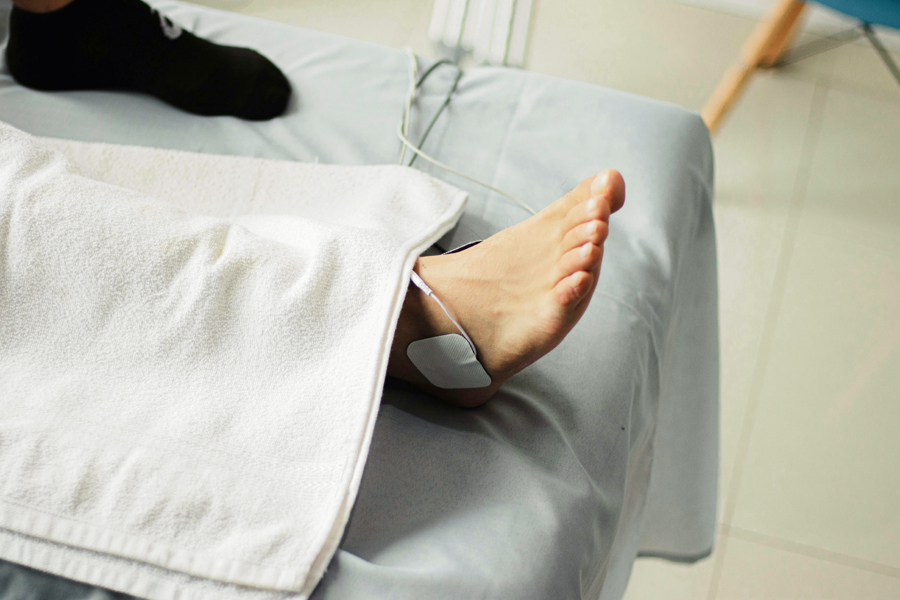
A client’s health history is evaluated to determine if FSM is appropriate. The client lies on a treatment table, and the skin is is cleaned, and conductive gel patches are applied to the treatment area and connected to a microcurrent device. The device is turned on and delivers very low-level electrical currents to the treatment area. Treatment lasts between 30 minutes to 1 hour. The frequency and intensity of the microcurrent device may be adjusted during the treatment. The electrodes are then removed, as is any remaining conductive gel. Mild discomfort or tingling during the treatment may be experienced, but this should subside after the session.
Because it has few side effects, FSM suits many people looking to reduce pain and improve their quality of life. This group includes individuals with acute or chronic pain, injuries, or inflammatory conditions.
Research
Adams, J., & McMakin, C. (2017). Frequency specific microcurrent resolves chronic pain and adhesions after ulnar transposition surgery. Journal of Novel Physiotherapy and Rehabilitation.
Armstrong, K., Gokal, R., Durant, J., et al. (2017). The Successful Treatment of Chronic Pain Using Microcurrent Point Stimulation Applied to Scars. International Journal of Complementary & Alternative Medicine.
Burnham, B., Katholi, B., & Burke, D. (2019). Complex regional pain syndrome treated with frequency specific microcurrent: A case report. Archives of Physical Medicine and Rehabilitation.
Chaikin, L., Kashiwa, K., Bennet, M., et al. (2015). Microcurrent stimulation in the treatment of dry and wet macular degeneration. Clinical Ophthalmology.
Cook, H., Morales, M., La Rosa, E., et al. (1994). Effects of electrical stimulation on lymphatic flow and limb volume in the rat. Physical Therapy.
Curtis, D., Fallows, S., Morris, M., et al. (2010). The efficacy of frequency specific microcurrent therapy on delayed onset muscle soreness. Journal of Bodywork and Movement Therapies.
Gregory, W., Bagley, K., Eng, S., et al. (2025). Frequency-specific microcurrent improves hand function and Raynaud’s symptoms in scleroderma: Results of two pilot studies. Rheumatology.
Guan, L., Fan, P., Wang, Y., Liu, X., Liu, R., Ma, W., & Bai, H. (2023). Lymphangiogenic responses of lymphatic endothelial cells to steady direct-current electric fields. Cell adhesion & migration, 17(1), 1–14. https://doi.org/10.1080/19336918.2023.2271260
Harikrishna, K. (2018). Microcurrent as an adjunct therapy to accelerate chronic wound healing and reduce patient pain. Journal of Wound Care.
Huckfeldt, R., Mikkelson, D., Larson, K., et al. (2003). The use of micro current and autocatalytic silver-plated nylon dressings in human burn patients: A feasibility study. Frequency Specific Microcurrent.
Kang, D., Jeon, J., & Lee, J. (2015). Effects of low-frequency electrical stimulation on cumulative fatigue and muscle tone of the erector spinae. Journal of Physical Therapy Science.
Kolimechkov, S., Seijo, M., Swaine, I., et al. (2023). Physiological effects of microcurrent and its application for maximising acute responses and chronic adaptations to exercise. European Journal of Applied Physiology.
Lennox, A., Shafer, J., Hatcher, M., et al. (2002). Pilot study of impedance-controlled microcurrent therapy for managing radiation-induced fibrosis in head-and-neck cancer patients. International Journal of Radiation Oncology, Biology, Physics.
Malin, E., Galin, C., Lairet, K., et al. (2013). Silver-coated nylon dressing plus active DC microcurrent for healing of autogenous skin donor sites. Annals of Plastic Surgery.
McMakin, C. (2004). Microcurrent therapy: A novel treatment method for chronic low back myofascial pain. Journal of Bodywork and Movement Therapies.
McMakin, C. (1998). Microcurrent treatment of myofascial pain in the head, neck, and face. Frequency Specific Microcurrent.
McMakin, C. (2017). Nonpharmacologic treatment of neuropathic pain using frequency specific microcurrent. Frequency Specific Microcurrent.
McMakin, C. (2010). Nonpharmacologic treatment of shingles. Practical Pain Management.
McMakin, C., Gregory, W., & Phillips, T. (2005). Cytokine changes with microcurrent treatment of fibromyalgia associated with cervical spine trauma. Journal of Bodywork and Movement Therapies.
McMakin, C., & Oschman, J. (2013). Visceral and somatic disorders: Tissue softening with frequency-specific microcurrent. Journal of Alternative and Complementary Medicine.
Mercola, J., & Kirsch, D. (1995). The basis for microcurrent electrical therapy in conventional medical practice. Frequency Specific Microcurrent.
Noites, A., Nunes, R., Gouveia, A., et al. (2015). Effects of aerobic exercise associated with abdominal microcurrent: a preliminary study. Journal of Alternative and Complementary Medicine.
Rajpurohit, B., Khatri, S., Metgud, D., et al. (2010). Effectiveness of transcutaneous electrical nerve stimulation and microcurrent electrical nerve stimulation in bruxism associated with masticatory muscle pain — A comparative study. Indian Journal of Dental Research.
Sharp, S., Huynh, M., & Filart, R. (2019). Frequency-specific microcurrent as adjunctive therapy for three wounded warriors. Medical Acupuncture.
Shetty, G., Rawat, P., & Sharma, A. (2020). Effect of adjuvant frequency-specific microcurrents on pain and disability in patients treated with physical rehabilitation for neck and low back pain. Journal of Bodywork and Movement Therapies.
Thompson, R., & Kaplan, S. (2019). Frequency-specific microcurrent for treatment of longstanding congenital muscular torticollis. Pediatric Physical Therapy.
Zhao Z, Qin L, Reid B, Pu J, Hara T, Zhao M. Directing migration of endothelial progenitor cells with applied DC electric fields. Stem Cell Res. 2012 Jan;8(1):38-48. doi: 10.1016/j.scr.2011.08.001. Epub 2011 Aug 16. PMID: 22099019; PMCID: PMC3238468.
Additional Information
Frequency-specific microcurrent | Cleveland Clinic
Frequency-specific microcurrent | Dr. Nick
History of the FSM process | Frequency Specific
How does a TENS unit work? | TENS Units