
AMTA Code of Ethics
This Code of Ethics is a summary statement of the standards of conduct that define ethical behavior for the massage therapist. Adherence to the Code is a prerequisite for admission to and continued membership in the American Massage Therapy Association (AMTA).
Principles of Ethics
The Principles of Ethics form the first part of the Code of Ethics. They are aspirational and inspirational model standards of exemplary professional conduct for all members of the association. These Principles should not be regarded as limitations or restrictions but as goals for which members should constantly strive.
Massage therapists/practitioners shall:
1. Demonstrate commitment to provide the highest quality massage therapy/bodywork to those who seek their professional service.
2. Acknowledge the inherent worth and individuality of each person by not discriminating or behaving in any prejudicial manner with clients and/or colleagues.
3. Demonstrate professional excellence through regular self-assessment of strengths, limitations and effectiveness by continued education and training.
4. Acknowledge the confidential nature of the professional relationship with clients and respect each client’s right to privacy within the constraints of the law.
5. Project a professional image and uphold the highest standards of professionalism.
6. Accept responsibility to do no harm to the physical, mental and emotional well-being of self, clients and associates.
Rules of Ethics
The Rules of Ethics are mandatory and direct specific standards of minimally acceptable professional conduct for all members of the association. The Rules of Ethics are enforceable for all association members, and any members who violate this Code shall be subject to disciplinary action.
Massage therapists/practitioners shall:
1. Conduct all business and professional activities within their scope of practice and all applicable legal and regulatory requirements.
2. Refrain from engaging in any sexual conduct or sexual activities involving their clients in the course of a massage therapy session.
3. Be truthful in advertising and marketing, and refrain from misrepresenting his or her services, charges for services, credentials, training, experience, ability or results.
4. Refrain from using AMTA membership, including the AMTA name, logo or other intellectual property, or the member’s position, in any way that is unauthorized, improper or misleading.
5. Refrain from engaging in any activity which would violate confidentiality commitments and/or proprietary rights of AMTA or any other person or organization.
Effective Date May 1, 2010
Online Pharmacies
With the advent of the newest virus and physicians afraid or refusing to order certain medications to treat it, there have been several online pharmacies which have been established to help those patients who are otherwise unable to obtain certain medications. These pharmacies usually team up with practitioners who will also assess and prescribe these meds, in order to create a streamlined system. Several of them also offer kits which contain various drugs, prefilled for emergencies.
All Family Pharma
Jase Medical
Pharmacy Mall – Canada
The Wellness Company
The content of this site, such as text, images, graphics, and other material, is for informational purposes only. This content is not intended to be a substitute for professional medical advice, diagnosis, or treatment. Always seek the advice of a qualified physician or other health provider regarding any medical condition.

Essential Oils to Aid Lymphatics
There are several essential oils which have been found to aid in the treatment of lymphatic diseases.
About Essential Oils
Hazardous Essential Oils
Oils which are potentially hazardous include the following:
Bitter Almond, Boldo Leaf, Calamus, Camphor (yellow), Horseradish, Jaborandi Leaf, Mugwort, Mustard, Pennyroyal, Rue, Sassafras, Savin (Juniperus sabina), Southernwood, Tansy, Thuja, Western Red Cedar (Thuja plicata), Wintergreen, Wormseed, and Wormwood.
Oils that should not be used during pregnancy include:
Aniseed, Basil, Cinnamon, Clary Sage, Cypress, Fennel, Hyssop, Jasmine, Juniper, Marjoram, Myrrh, Origanum, Peppermint, Rose, Rosemary, Sage, and Thyme.
Oils that should not be used for those individuals with epilepsy include:
Camphor, Fennel, Hyssop, and Sage.
Avoid using these oils topically or diffusing in a small closed room with pets. These oils are toxic or high in ketones or phenols:
Anise, Birch, Bitter Almond, Blue Tansy, Camphor, Cassia, Clove, Garlic, Hyssop, Mugwort, Mustard, Oregano, Pennyroyal, Rue, Savory, Tea Tree, Thuja, Wintergreen, Wormwood, and Yarrow.
https://www.revive-eo.com/pet-safety-oils/
Natural Oils for Lymphatic Massage
Jojoba oil is a popular choice for lymphatic drainage massage due to its lightweight texture and excellent absorption properties. It is rich in vitamins E and B, which nourish the skin and promote healing, plus its anti-inflammatory properties make it ideal for soothing irritated skin.
Sweet almond oil is another excellent option for lymphatic drainage massage. It is packed with vitamins A, E, and D, as well as fatty acids that moisturize and nourish the skin. Its smooth texture allows for easy application and gliding during the massage, making it a favorite among massage therapists.
Grapeseed oil is a lightweight and non-greasy oil that is perfect for lymphatic drainage massage, as it contains antioxidants and essential fatty acids that help detoxify the skin and improve its overall health. Its astringent properties also make it beneficial for tightening and toning the skin.
Coconut oil is known for its numerous health benefits, and it can be a valuable addition to lymphatic drainage massage. It is rich in medium-chain fatty acids, which have antimicrobial properties and support skin health. It also provides deep hydration and leaves the skin feeling soft and smooth.
Rosehip oil is a potent oil known for its regenerative properties and is rich in essential fatty acids, vitamins A and C, and antioxidants that promote skin healing and rejuvenation. It can help improve the appearance of scars, stretch marks, and uneven skin tone, making it a valuable addition to lymphatic drainage massage.
Hartley, E. (2024). Lymphatic drainage with natural oils. O&3.
Fritz, S., & Fritz, L. (2021). Fundamentals of Therapeutic Massage. Elsevier.
Clove
About Clove
Clove | Science Direct
Quigless, C. (2024). 6 essential oils for lymphatic drainage massage. Massage Magazine.
Eucalyptus
About Eucalyptus
Eucalypt | Science Direct
Quigless, C. (2024). 6 essential oils for lymphatic drainage massage. Massage Magazine.
Geranium
About Geranium
Geranium | Science Direct
Quigless, C. (2024). 6 essential oils for lymphatic drainage massage. Massage Magazine.
Helichrysum
About Helichrysum
Helichrysum | Science Direct
What are the benefits of helichrysum essential oil? | Medical News Today
Hersh, E. (2024). Everything you need to know about helichrysum essential oil. Healthline.
Judzentiene, A., Budiene, J., Nedveckyte, I., & Garjonyte, R. (2022). Antioxidant and toxic activity of Helichrysum arenarium. Molecules.
Thyme
About Thyme
Thyme | Science Direct
Quigless, C. (2024). 6 essential oils for lymphatic drainage massage. Massage Magazine.
More About Essential Oils
6 essential oils for lymphatic drainage massage | Massage Magazine
Aromatherapy | National Center for Complementary and Integrative Health
Aromatherapy with essential oils — Patient version | National Cancer Institute
Aromatherapy with essential oils — Health professional | National Cancer Institute
The content of this site, such as text, images, graphics, and other material, is for informational purposes only. This content is not intended to be a substitute for professional medical advice, diagnosis, or treatment. Always seek the advice of a qualified physician or other health provider regarding any medical condition.

About Lipedema
Lipedema occurs almost exclusively in women; as of this date, there have been a few known cases diagnosed in men. Despite an uptick in recent research, there is still much to be learned about the disease, and there is no cure. Treatment focuses on attempting to suppress further development and removal of the diseased tissue through liposuction.
Although first described in research from 1940 by Drs. Allen and Hines of the Mayo Clinic, many physicians remain unaware of lipedema or its symptoms. Lipedema is known by many names: lipoedema, lipoedem, and lipodem in other countries, “lipalgia syndrome” or “painful fat syndrome,” “lipohypertrophy dolorosa” (“LiDo”) or “adiposis dolorosa” which highlight the painful abnormal fat accumulation in the legs, and “lipo-lymphedema,” which is the term used when lipedema progresses and affects the lymphatic system.
Lipedema is a chronic, progressive disease that causes a disproportionate amount of swollen lipomas and affects the legs and/or arms bilaterally. Patients with lipedema find that the legs swell and ache upon standing/walking for long periods of time. The lipomas are hardly affected by either diet or exercise and can only be removed by special lymph-sparing surgery, which is not routinely covered by insurance, nor does most insurance cover the compression garments which are critical to postoperative care and life-long treatment of lipedema. Insurance carriers as well do not cover the many supplements needed to try to control advancement of the disease.
Lipedema presents as symmetrical accumulation of deposits of painful fat in subcutaneous tissue that disproportionately affects the lower limbs, anywhere from buttocks to ankles, although there are several places where it develops, and these are termed the “types” of lipedema (see below). The condition is associated with easy bruising due to fragile blood vessels, and the legs are usually very sensitive and painful to touch, as the capillaries “leak.” In about a third of women, the arms can also accumulate distinct patterns of fatty tissue. A genetic component to the disease is suspected, and development can occur at times of hormone changes in women: puberty, hysterectomy, menopause.
Until a few years ago, there was no research being done of lipedema, and 80 years later, many physicians still do not recognized it and generally misdiagnose it as simple obesity or even lymphedema. It is only in the recent two decades or so that interest and education about lipedema has been gaining awareness, even though it is estimated that 11% of women — 1 in 9 — have the disease. According to the American Cancer Society, the average risk of a woman in the United States developing breast cancer sometime in her life is about 13% — 1 in 8, and yet, despite being almost as prevalent as breast cancer, lipedema remains relatively ignored by our medical system and the insurance industry.
The lack of awareness of lipoedema among healthcare providers was reflected in low scores on the The Swedish National Patient Survey dimension of knowledge and information. The women described this as the main reason for not receiving a diagnosis or adequate information on their health condition. The qualitative data generated a theme — the impact of lack of knowledge in care — pointing out the women’s experiences with healthcare providers failing to explain women’s health problems. It has been previously known that medically unexplained symptoms may strain the relationship between the patient and provider, contributing to mutual feelings of being stuck, lack of trust, and a sense of helplessness.
From the 2025 research paper Dealing with lipoedema: Women’s experiences of healthcare, self-care, and treatments — a mixed-methods study.
As lipedema worsens, the affected limbs feel heavy and can be painful. Because of the lack of awareness, many women remain undiagnosed, receiving no treatment until they have progressed to advanced stages, when mobility is affected due to the location and weight of the lipomas, both of which create joint deformities in the lower limbs and an abnormal gait over time — see Lipedema’s Effects on Gait.
Stages of Lipedema
Lipedema is categorized in stages by levels of development. These classifications include skin surface and the amount of loose connective tissue present. Lipedema tissue (and therefore body mass index), lymphedema, metabolic disease and lymphedema increase with stage.

Stage I — Skin surface is normal. Subdermal nodules due to underlying loose connective tissue fibrosis are present.
Stage II — Skin surface is uneven, and dimpling is present due to progressed fibrotic changes and excess tissue. Palpable nodules may be more numerous and larger. In arms, tissue begins to hang off the arm, those patients with full arm involvement show a more pronounced wrist cuff.
Stage III — There is lobular deformation of skin. There are numerous large subdermal nodules and deformities of overhanging lobules of increased lipedema tissue which is more fibrotic in texture.
To learn more about stages of lipedema, see Staging by the Lipedema Foundation or Stages and Types of Lipedema by Dr. Thomas Wright.
Types of Lipedema
Lipedema is also categorized by the distribution of subcutaneous adipose tissue, which is termed the Schingale classification.
Type I — Lipedema tissue is present under the umbilicus and over hips and buttocks
Type II — Lipedema tissue is present under the umbilicus to the knees (saddle bag or jodhpur phenomenon)
Type III — Lipedema tissues is present under the umbilicus to the ankles
Type IV — Lipedema tissue is present in the arms
Type V — Lipedema tissue is present in the calves
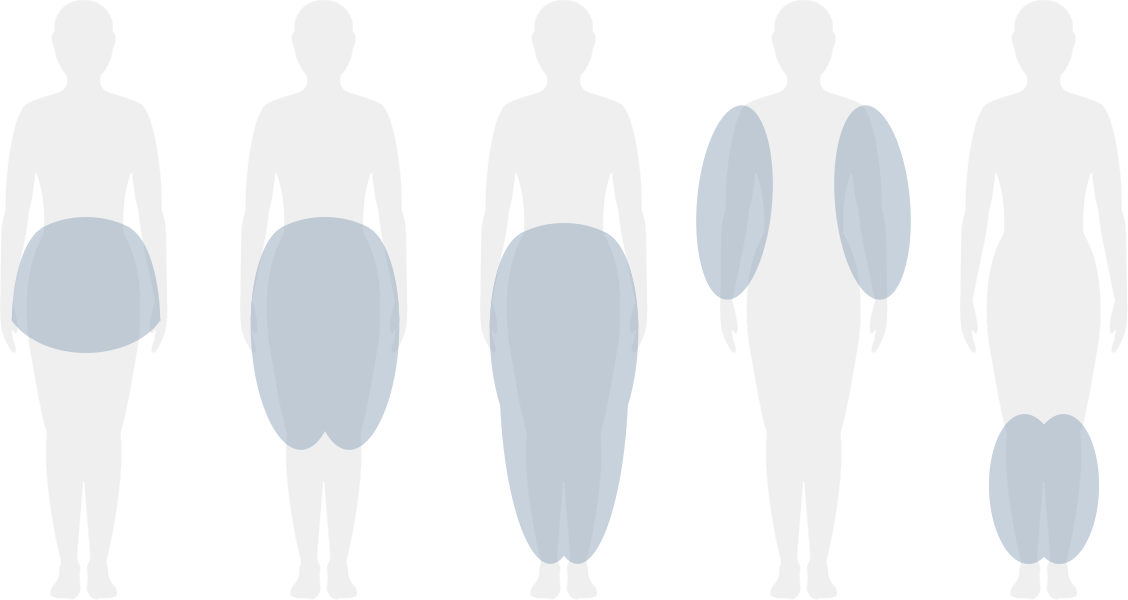
To learn more about types of lipedema, see Stages and Types of Lipedema by Dr. Thomas Wright.
Treatment of Lipedema
A multi-pronged approach is needed for women with lipedema. Standard treatment recommendations for lipedema include the following:
— Complete decongestive therapy to include manual lymphatic drainage
— Increasing metabolism through exercise by activating the muscle pump to improve venous and lymphatic flow and muscle fitness
— Low-carbohydrate nutritional plans to keep obesity at bay
— Skin care to reduce dryness and cracks that increase the risk for infection, especially when lymphedema is present
— Wearing compression garments to assist in moving lymph and helping to prevent fibrosis
— Use of sequential pneumatic compression pumps to move lymph
Allen, M., Schwartz, M., & Herbst, K. (2020). Interstitial fluid in lipedema and control skin. Women’s Health Reports.
Falck, J., Nygardh, A., Rolander, B., et al. (2025). Dealing with lipoedema: Women’s experiences of healthcare, self-care, and treatments — a mixed-methods study. BMC Women’s Health.
Herbst, K., et al. (2021). Standard of care for lipedema in the United States. Phlebology.
Szyplowska, M., Gorecka, A., Kus, A., et al. (2020). Diagnosis and management of lipoedema — A review paper. Journal of Education, Health & Sport.
Torre, Y., Wadeea, R., Rosas, V. et al. (2018). Lipedema: Friend and foe. Hormone Molecular Biology and Clinical Investigation.
New Patient Folder
New to lipedema? The Fat Disorders Resource Society has designed a lipedema folder for the newly-diagnosed patient. This folder highlights the various treatments for lipedema and is perfect for doctors and therapists to provide to their patients. FDRS asks for a donation of $4 to cover the cost of printing the folder, shipping, and handling.
Additional Information
Complete Decongestive Therapy
Goals of Lipedema Care
Improving Lymphatic Function
Lipedema Resources in the US
Lipedema’s Effects on Gait
Videos About Lipedema